Naples’ Infernal Bliss

Naples, Italy is the most peaceful city on the planet–at least it seems that way when looking down on it from high above. Its narrow, laundry strewn streets appear still and almost lifeless. A steady stream of morning fog from the bay hovers over the sprawl of post-war apartment blocks. The mountainous isle of Capri peeks coyly through the fog. Even the usually ominous Mount Vesuvius–the volcano whose eruption instantly buried the nearby city of Pompeii in 79 A.D.–looks like just another cloudy hilltop. I’m standing on the roof of the Castel Sant’ Elmo, a massive 14th-century fortification that’s perched on the mountaintop district of Vomero, far removed from the infamous chaos of southern Italy’s most densely inhabited metropolis. Before I venture down to what some have described as a crime-ridden hell, a logic-defying jumble of streets, a concrete jungle where obeying traffic laws is beneath consideration, I want to see what I’m up against.

The Grand Tourists–those 19th-century upper-class Brits whose classical education was not complete until they toured the great cities of Europe–used to forego Rome for Naples. They came to see the Caravaggios and the Correggios, the Raphaels and the Riberas. They came to observe the goings-on at one of Europe’s oldest universities. They came to see how the Greeks’ first colony on the Italian peninsula (called Neapolis, or “New Town” in 470 B.C.) had evolved into what a European monarch once said was, “the most beautiful crown in Italy.” Some modern tourists still come for these reasons. Others are drawn to Naples for its uniquely chaotic splendor–to see a modus vivendi unfathomable in Baltimore or Brussels, Munich or Miami.

I came for a different reason. Pizza. Yes, pizza in Naples. It’s impossible to utter the topic today without thinking of two words: Elizabeth Gilbert. But good food is transcendent. And pizza, a dish that may be the most popular in the world, will transcend literary references as well. Especially here, where it’s ubiquitous. It’s impossible to be in this town of nearly a million people and not eat pizza. Naples credits itself as being the birthplace of the pizza–the first recorded evidence of which is from the 16th century. My guidebook says that the more rundown the pizzeria, the better its product will be. I had to find out for myself.

As I stomp down the long cobbled steps toward the historical center, I pass old villas with chipped facades and green shutters. Bristly weeds grow through the steps’ cracks. In an open window a cell phone rings–to the sound of the Doors’ “Light My Fire.” From the next villa the sweet smell of fresh bread–or is it pizza dough?–pours out at me. The hilltop residents here labored up and down these same steps for centuries. Today, they take one of three funicular railways that clank up the mountain. Colorful shrines to the Virgin are fixed at almost every bend on the stairway, some of which are decorated with neon lights, evidence that these shrines are more than just a relic of the past. I wonder if there’s an Our Lady of the Pizza Pie. In this city, there should be.

My Roman friends warned me about Naples before I took the two-hour train ride south. “Neapolitans are criminals, but they have a great sense of humor,” said my friend Enrico, which I suppose is some kind of consolation, since he followed up by saying that Sicilians, on the other hand, are just criminals. As I enter the most cramped quarter of the city, the Quatieri Spagnoli, the solitude of the hilltop fortress is already far behind me. Cars race by. Scooters whine. Medallion-wearing fat men bellow at one another. Two women stand on a side street yelling at each other and gesturing wildly. This is Naples: they’re probably just trading recipes. Three teenage boys and a dog ride past me on a scooter looking like they’ve done this a gazillion times. Behind them is another scooter driven by a man with two kids tucked onto the seat in front of him. Seconds later, another scooter zips by–this time it’s a man riding shockingly alone, and even wearing a helmet (!)–who is managing to talk on his cell phone and eat a piece of pizza.

I consider entering the first pizzeria I see, a dilapidated looking place, until the cook, leaning against the front doorway, begins violently coughing, gurgling up things I don’t want to think about. Instead, a block further, I find a seat at a slightly nicer pizzeria, which doesn’t appear to have a name. The minimalist (or, some would say, “indifferent”) interior–slate marble tables and blank walls–are a nice contrast to the disorder just outside the door. There are two pizza choices: the marinara (tomato, oregano, garlic, and oil) and the margherita (tomato, basil, oil, mozzarella). I go with the latter. The dough is thicker here in southern Italy, and there are socio-economic reasons for this: historically, the south has always been poorer than the north. To make their pizza more substantial, southern Italians used excess amounts of dough, which is cheap, and less toppings, which are costlier. American-style pizza is so thick because it was the poor southern Italians who immigrated to the United States in hope of a better life.

While eating my first Neapolitan pizza, I begin to wonder if life can get any better. It’s something about the San Marzano tomato sauce, which along with the melted mozzarella, is bubbling like volcanic lava. It’s tangy and delicious. The beauty of dining in Italy, especially the further south one travels, is the informality of it all. The waiter, often the restaurant’s owner, takes orders by memory and then when it comes time to pay, he tallies the bill in front of the customer, sometimes adding up the total on the paper table cloth. Wine comes in a ceramic jug and is often drunk from a glass tumbler.

After lunch, I’m not ready to battle the racing scooters and the mess of strolling crowds again, so I take a quick left down an alleyway lined with merchandise for sale and crammed with black down jacket-wearing locals. Everyone mills about, like they have no direction; like their ancestors have done for centuries. “Musica! Right here!” screams a grey-mustached man hocking illegally made CDs. Anything can be bought or sold here: jewelry, incense, clothes, shoes, car parts, fried things. My favorites are the fish salesmen who seem to be on nearly every block in the Centro Storico. The seafood is fresh to the point of still being alive: two-foot-long unidentifiable sea creatures squiggle through murky shallow water, hundreds of snails jiggle in a rusty, metal bucket, and long slimy eels gracefully slide past one another in a makeshift Styrofoam tank.

It’s now late afternoon, and it feels that every resident of Naples is packed into these tiny streets. This is the first circle of Dante’s hell that I was anticipating as I stood safely on the mountaintop earlier this morning. People are pressed up to me on all sides. We sway back and forth, moving two inches at a time, as we slowly pass shop windows displaying shoes, bags, and clothes. The ubiquitous rattle and screech of scooters attacks my ears. Everyone is smiling and greeting one another. This is normal. This is Naples. I’ve got a death grip on my wallet.

And, just then, I spot in the distance, another pizzeria. A real ramshackle one, whose name is also not so obvious, with a paint-chipped façade that looks like it had its last makeover during the interwar Fascist period. I’m not really hungry but my Rome-bound train is leaving soon and, who knows when I’ll be back.

“Marinara or Margherita,” the waiter asks.

I order and then take a deep breath and watch the maddening crowds outside. Naples, I decide, is much better with an escape. But between viewing it from a hilltop fortress or sitting in front of a bubbling pizza, I’ll take the pizza any day.

David Farley is the author of An Irreverent Curiosity: In Search of the Church’s Strangest Relic in Italy’s Oddest Town.
Teva introduces flip flops with lights – and you can win a pair!

With Spring hitting the Northeast early, we’re thrilled to be able to start thinking about trips to the beach, hikes in the woods and some new camping adventures. And warm weather means throwing those Winter boots aside in favor of flip flops. Our feet haven’t seen the light of day in months and it’s time to let those dogs breathe. With that in mind, we were psyched (and a tad amused) to see that Teva is launching a new flip flop with LED lights attached. We’re also pretty jazzed that we have a pair to give away to one lucky reader.

The Teva illūm is a new of sandal that gives you a powerful LED light on each foot. The 10-foot beams of light are intended to help keep you safe when the sun sets and you find yourself on the trail, looking for your campsite or seeking a clandestine spot on the beach to make out with your date. While it may seem gimmicky, we’re actually rather intrigued by the idea of having sandal-mounted lights to help guide the way. Sure, you should still pack a headlamp for any night hikes or camping trips, but extra light is never a bad thing.

The Teva illūm will be available on the Teva website beginning on May 1, 2010 and you can learn more about the sandals on their own unique site. They will be available in synthetic and waterproof leather for $50 and $60, respectfully.

But you can get your hands on a pair for free before they even hit stores. Gadling and Teva want to give to one lucky reader a pair of illūm sandals. We plan to have an official Gadling review on the site later this Spring. In the meantime, perhaps our winner can give us some feedback.

To enter to win these sandals, simply leave a comment below stating the place you’d least like to find yourself in the dark. Maybe it’s in the foggy English countryside. Perhaps it’s alone in Death Valley. Or maybe it’s just in your own attic. Wherever it is, let us know in the comments and one person will be randomly selected to win a pair of Teva illūm sandals.

  • The comment must be left before Friday, April 2 at 5:00 PM Eastern Time.
  • You may enter only once.
  • One winner will be selected in a random drawing.
  • The winner will receive pair of Teva illūm sandals (valued at $50).
  • Click here for complete Official Rules.
  • Open to legal residents of the 50 United States, including the District of Columbia who are 18 and older.

GadlingTV’s Travel Talk 006: New York City, Engadget Show, Strikes & Protests!


GadlingTV’s Travel Talk, episode 6 – Click above to watch video after the jump

Ready for the City that Never Sleeps? This week we’re hitting the streets of Manhattan for a jam-packed episode that will take you through the Big Apple, behind the scenes of the Engadget Show, and show you how to get away from it all in a city like NYC.

This week we discuss the ongoing red-shirt protests in Thailand, the long awaited British Airways strike, significant new routes from Virgin America, a bus journey from D.C to Antarctica, and how NYC’s metro matches up against one of the most modern metros in the world.

Of course, there’s more Travel Tips with Bruce! and an epic Adventure that only left one of us curled up in a bathroom…

If you have any questions or comments about Travel Talk, you can email us at talk AT gadling DOT com.

Subscribe via iTunes:
[iTunes] Subscribe to the Show directly in iTunes (M4V).
[RSS M4V] Add the Travel Talk feed (M4V) to your RSS aggregator and have it delivered automatically.

Hosts: Stephen Greenwood, Aaron Murphy-Crews, Drew Mylrea
Special guests: Mike Barish, Joshua Topolsky, and Bruce!
Produced, Edited, and Directed by: Stephen Greenwood, Aaron Murphy-Crews, Drew Mylrea
Special thanks: Chad Mumm & the Engadget Team

Music:

Camping with Mike
“Camp Walk”
Derek K Miller

Travel Tips with Bruce
“Sonata in E-flat Major, Hob. XVI:49, III. Tempo di Minuet”
Mario Ajero

Engadget Show
“Le Conseil Militair pour la Justice”
Adhesion

Adventure of the Week
“New York City Heat”
Dead Heart Bloom

“Indian Funk”
Bloingo

all songs courtesy of Musicalley.com

The Summer Redneck Games: A Hootin’ Good Time!

Starting today, Gadling is taking a look at our favorite festivals around the world. From music festivals to cultural showcases to the just plain bizarre, we hope to inspire you to do some festival exploring of your own. Come back each week for our picks or find them all HERE.

Each July, nearly 100,000 visitors descend on East Dublin, Georgia to participate in a one-of-a-kind event known as the Summer Redneck Games. This unique festival is a celebration of “all things Redneck” including special feats of athleticism, a variety of culinary treats and plenty of fun.

The story of the Redneck Games begins in 1996 before the Atlanta Olympics. After outsiders began making fun of “Rednecks” who were hosting the games, a group of volunteers decided to do something about it. Enterprising locals took critics’ remarks as a challenge, organizing their very own “Redneck Games” and agreed to donate the proceeds from the event to charity. In its inaugural year, more than 5,000 visitors showed up. The organizers knew they were on to something. Over the last decade, the Redneck Games have continued to grow, with participation reaching 95,000 rednecks during the annual one-day July extravaganza.

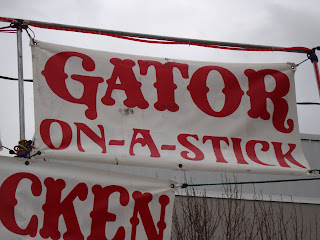
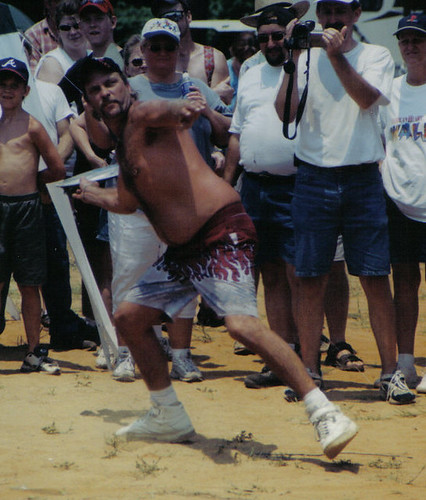
Much like the Olympic games, the Redneck Games hosts a number of challenging athletic events, but with a uniquely Redneck twist. Favorite contests include the Hubcap Hurl, the Bobbin’ for Pigs Feet Fest, Mud Wrestling, and a special contest called Redneck Horseshoes, which uses toilet seats in place of the standard iron game pieces. There’s also plenty of authentic Redneck foods for hungry spectators, including Corn Dogs, Alligator Kebabs and Elephant Ears. You’re also sure hear authentic Redneck slang like “y’all,” “fixin’ to,” “do what?,” and the all-time favorite (as coined by Redneck favorite, Larry the Cable Guy), “Git R’ Done!”

Though the Redneck Games would seem to be a decidedly local affair, it has slowly attracted fans from across the U.S. and around the world. As the event has become more popular, a steady stream of participants from “above the Mason-Dixon line” has joined in the fun, with events taking place as far away as Canada and a range of international media coverage.

There’s many misconceptions about the Games – critics decry the Redneck Games as nothing more than horseplay and drinking beer. But much like the comments the led to the event’s creation, event organizers and supporters have taken the remarks in stride. To its fans, the Redneck Games remain nothing but a silly, great time. Despite the increase in attendance and popularity, it remains much the same pure fun that it has always been.

Want to join in the craziness? Head down to Georgia this July 10th to check it out. Everyone is welcome – even Yankees…

Share your travel tips with Gadling and get published, paid


Have you ever looked at a travel blog and thought to yourself, “Boy, I could do that!”? Well, now’s your chance to “do that”!

Introducing Gadling’s brand new, 100% reader-generated feature, “100 words or less.” In “100 words or less,” YOU — the expert traveler — get to share your expert travel tips with Gadling and all our readers. Know a sure-fire way to score a cheap hotel room? Confident you know a trick to get an airline upgrade? Share it with us!

To submit your own tips, sign up for a free account at Seed, filter the assignment list by the category “travel” and look for assignment requests with the words “100 words or less.” (And yes: if your tip is published, you will be paid!)

Anticipating questions, here’s a quick FAQs:Q1. What kinds of tips are you looking for?

A1. Right now, we’re looking for tips covering the broad topics of Hotels, Road Trips, Cruises, Dining Out While Traveling, Souvenirs, Airplanes/Airlines, Traveling With Kids, Packing, and International Travel. We may launch more tips soon, but for now, this is the extent of our tips offering. HINT: Use your imagination (and your brains) and leave some good tips. We don’t really need any more “leave for the airport early” tips. No offense, but, um, we’re not gonna publish those. Have a look at our hub and see what kinds of tips we’ve published so far.

Q2. What if you don’t use my tip?

A2. If we don’t use your tip, don’t feel bad. We may have rejected it because someone else already submitted a similar tip. (After all, we can’t keep publishing the same tips.) Alternatively, perhaps the tip wasn’t the right fit for Gadling. Don’t be distraught. Submit another tip!

Q3. I have some great tips on my blog. Can I submit those?

A3. Sorry, but we’re only looking for tips that have not been published elsewhere. If you can come up with some tips for your blog, we bet you can come up with at least one more for Gadling.

Q4. What’s the pay like?

A4. For these tips — all of which are under 100 words in length — we’ll pay $10 per tip, paid via PayPal. You may submit as many as you like, and we’ll pay for all we publish.

Q5. I don’t have any travel tips, but I would like to contribute in other ways to Gadling. Is this possible?

A5. C’mon, everyone has travel tips! However, if you don’t feel inspired to submit some tips, there are other assignments in the queue relating to travel. (In fact, there are lots of different assignments in the Seed queue for all kinds of topics!) Sign up for an account, and we bet you find something to which you can contribute. In fact, we just added some more assignments to the queue, so go wild!

Q6. I don’t live in the US, but I have some great tips. Can I still participate?

A6. At this time, the Seed platform is US-only (but that’s changing soon). So, for now, we can only accept tips from US-based writers. We’ll update you when we know more.

Got more questions? Leave them in the comments, and we’ll answer them there. Good luck!